The Meatballs That Taught Me to Slow Down
Meatballs came out dense and springy instead of light and tender? Broth was cloudy and greasy instead of clear and clean? The texture collapsed or felt dry instead of feather-light? After ruining this Yangzhou banquet classic three different ways, I finally learned the secrets: hand-chop with visible texture, stir in one direction only, and simmer at a lazy bubble.

I’ve made lion’s head meatballs many times over the years, but it took me a long time to get them just right.
The first few times, I used a meat grinder to save time, but the meatballs turned out so dense they were as hard as golf balls—it was even hard to pierce them with chopsticks. Later, I switched to mincing the meat by hand, and the texture finally came out right, but a layer of oil floated on the surface of the broth, and the meatballs cracked open. Later still, the broth became clear and the meatballs held their shape, but they were dry and tough to chew—I just couldn’t recapture that light, cotton-like texture I’d enjoyed years ago at that restaurant in Yangzhou.
After several rounds of trial and error, I finally realized the problem wasn’t with the ingredients, but with the small details I’d overlooked—the knife work, the direction of mixing, and the heat level. Even a slight difference in each step made a huge difference in the final result.
Here is the method I finally worked out.
Ingredients
- Pork shoulder – 350 grams
- Pork belly – 150 grams (this gives a lean-to-fat ratio of about 7:3)
- Water chestnuts – 80 grams (if water chestnuts aren’t available, lotus root can be used as a substitute)
- White part of scallion – 25 grams (finely chopped); reserve the green part for garnish
- Fresh ginger – 20 grams (crushed, soaked in 80 milliliters of water for 10 minutes, then strained)
- Egg white – 1
- Potato starch – 18–20 grams (about 2 tablespoons)
- Shaoxing wine – 2 tablespoons
- Light soy sauce – 1½ tablespoons
- Salt – 4 grams (about 1 teaspoon)
- Rock sugar – 4–5 grams (about 1 small piece)
- White pepper – 1 gram (a small pinch)
- Unsalted chicken broth – 650 milliliters
- Napa cabbage leaves – about 120 grams
- Neutral cooking oil – 1 teaspoon
Prepare the Pork by Hand, Not with a Machine
The biggest mistake I made on my first attempt was using a food processor. At the time, I thought, “The finer the ground meat, the better the texture.” But for lion’s head meatballs, the opposite is true.
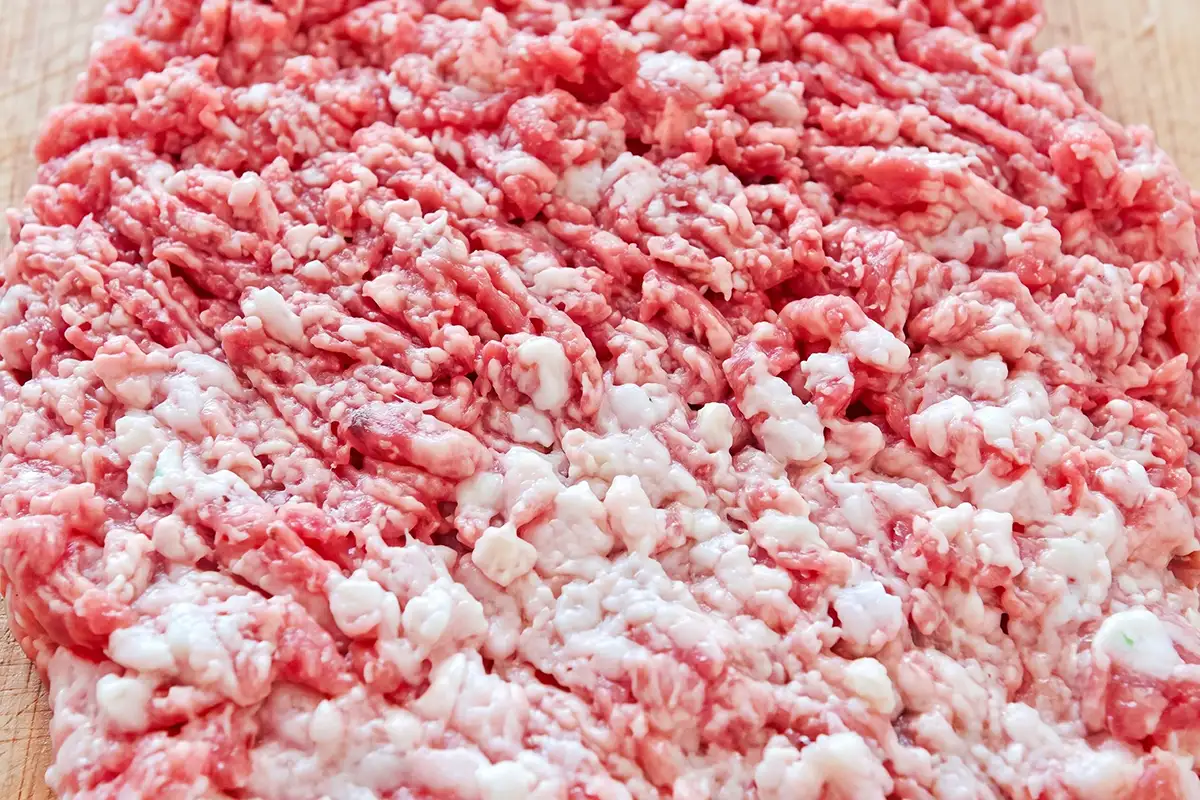
Chop the pork by hand. Here’s how: Cut the pork shoulder and pork belly into small cubes—about 1 centimeter on each side. Then, use a kitchen knife or a heavy knife to chop the meat until it becomes sticky but still retains a slightly coarse texture. At this point, you should still be able to see small pieces of meat, rather than a uniform paste.
Why is this important? When chopping meat by hand, you sever the muscle fibers without completely breaking down their structure. The irregular pieces trap air and fat, resulting in a light, tender texture. A food processor, on the other hand, grinds all the ingredients into a paste; meatballs made from this paste turn out dense and springy—suitable for sausages, but not for a Huaiyang-style banquet.
If you’re pressed for time and must use a food processor: Use short, intermittent pulses. Stop immediately once the meat is finely chopped but hasn’t turned into a paste. But honestly, it’s worth spending an extra five minutes mincing the meat by hand.
About Water Chestnuts
In my kitchen, water chestnuts are by no means a dispensable ingredient—they are the textural highlight of this dish. Dice them into small cubes, about the size of peas. Their slight crunch helps balance the rich flavor of the pork.
If you can’t find water chestnuts, lotus root is a good substitute—its texture is closest to that of water chestnuts, crisp and refreshing with a subtle sweetness. Simply dice it into the same small cubes; there’s no need to blanch it.
Mixing the Filling in the Correct Order
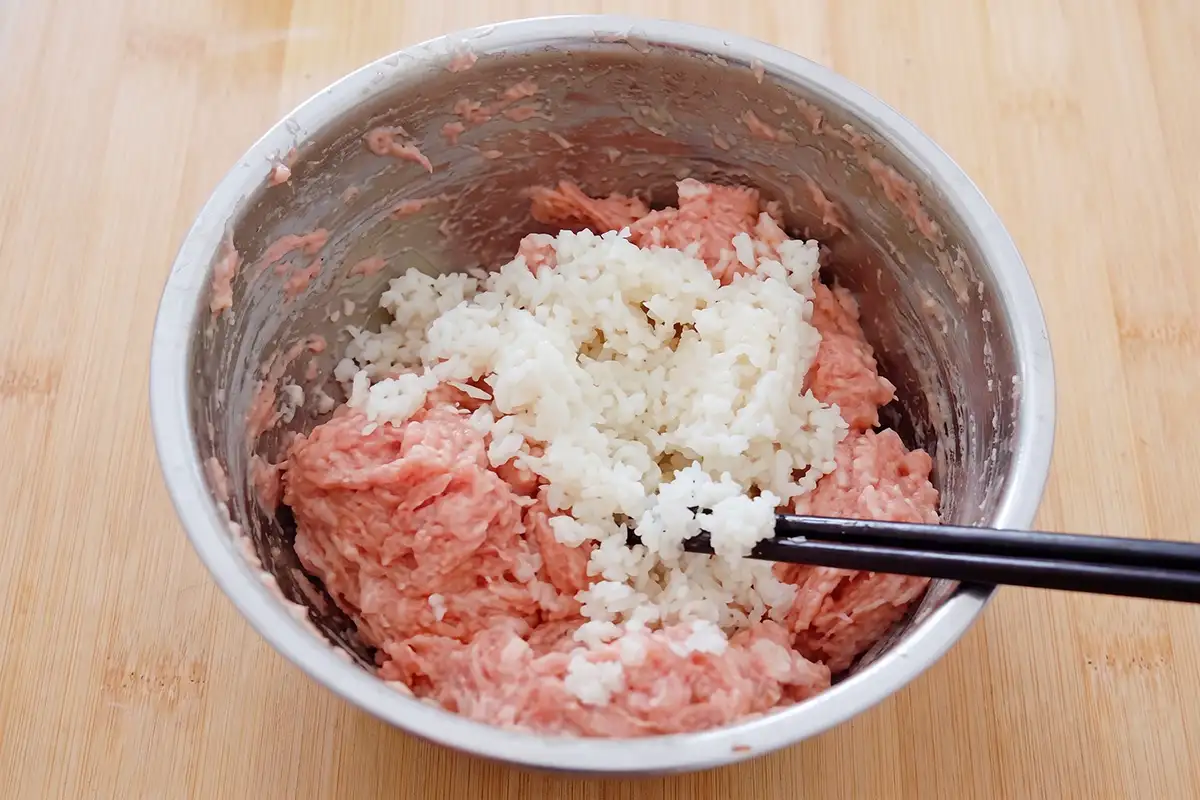
Prepare a large bowl. Place the hand-chopped pork into it.
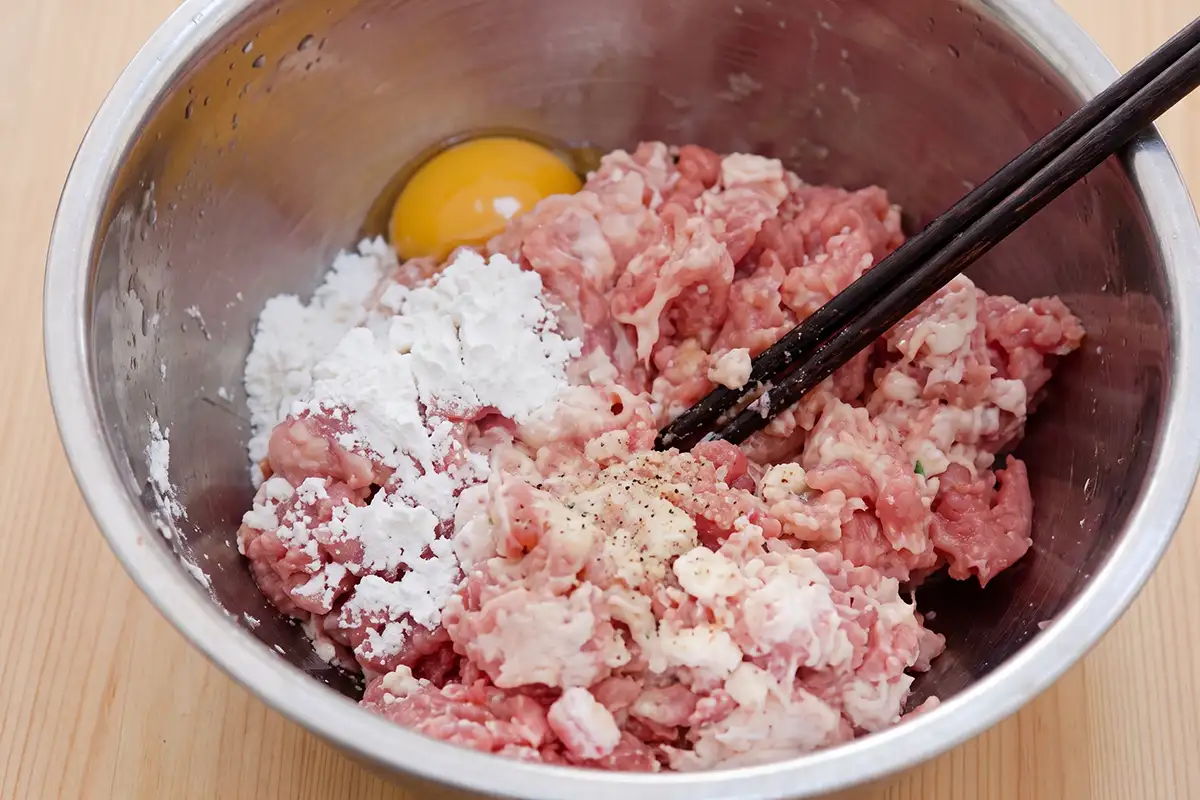
Add the egg white, potato starch, Shaoxing wine, light soy sauce, salt, rock sugar, and white pepper.
Now start mixing. Here’s a key point—mix in only one direction, and mix for just 2 to 3 minutes. Stop mixing when the meat mixture feels slightly sticky and begins to form a cohesive mass.
The first time I made this, I overmixed it—stirring for nearly 6 minutes—thinking that the more I stirred, the firmer the meat mixture would become. As a result, the meatballs turned out dense and springy, but they felt like rubber. Two to three minutes is the optimal mixing time.
Add the ginger water in three batches. First, pour in about one-third of it and stir until it’s fully absorbed, then add the next one-third, and so on. Adding the liquid in batches keeps the mixture moist while preventing it from becoming too wet or falling apart.
Gently fold in the white parts of the scallions and the water chestnuts. Do not stir vigorously at this stage—you want the water chestnut pieces to remain whole and not get mashed into a paste.
Do Not Squeeze When Shaping
Wet your hands before shaping—this prevents the meat mixture from sticking to your palms.
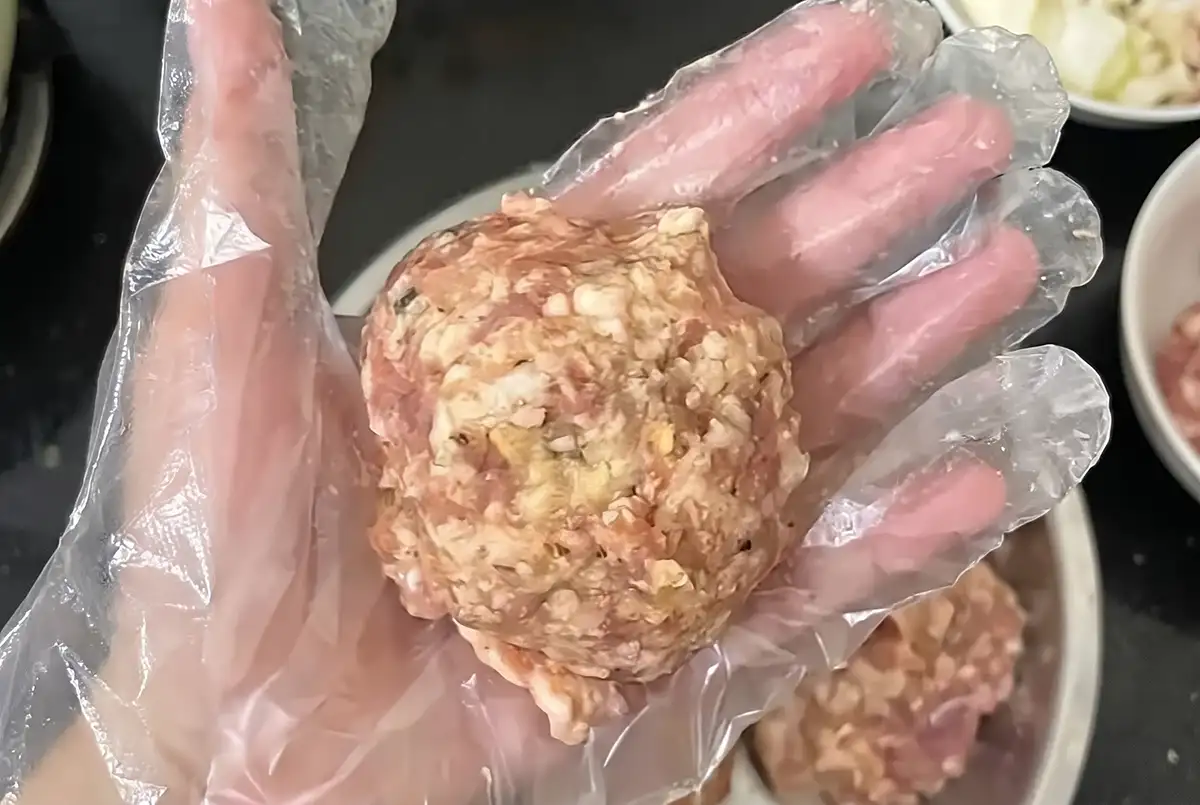
Divide the mixture into 4 portions, each weighing about 120 grams. Gently toss each portion between your palms 5 to 6 times. This gentle tossing firms up the surface texture without compacting the inside. Then shape it into a ball.
Do not press down hard. The meatball should feel loose and slightly fragile in your hands—that’s exactly the effect you’re aiming for. Pressing too hard will make the meatball dense.
Choosing the Right Cookware Is Crucial
Lightly coat the bottom of a heavy-bottomed pot with oil—a clay pot, Dutch oven, or heavy-bottomed stainless steel pot works best. Shallow pans are prone to hot spots, which can cause the meatballs to crack.
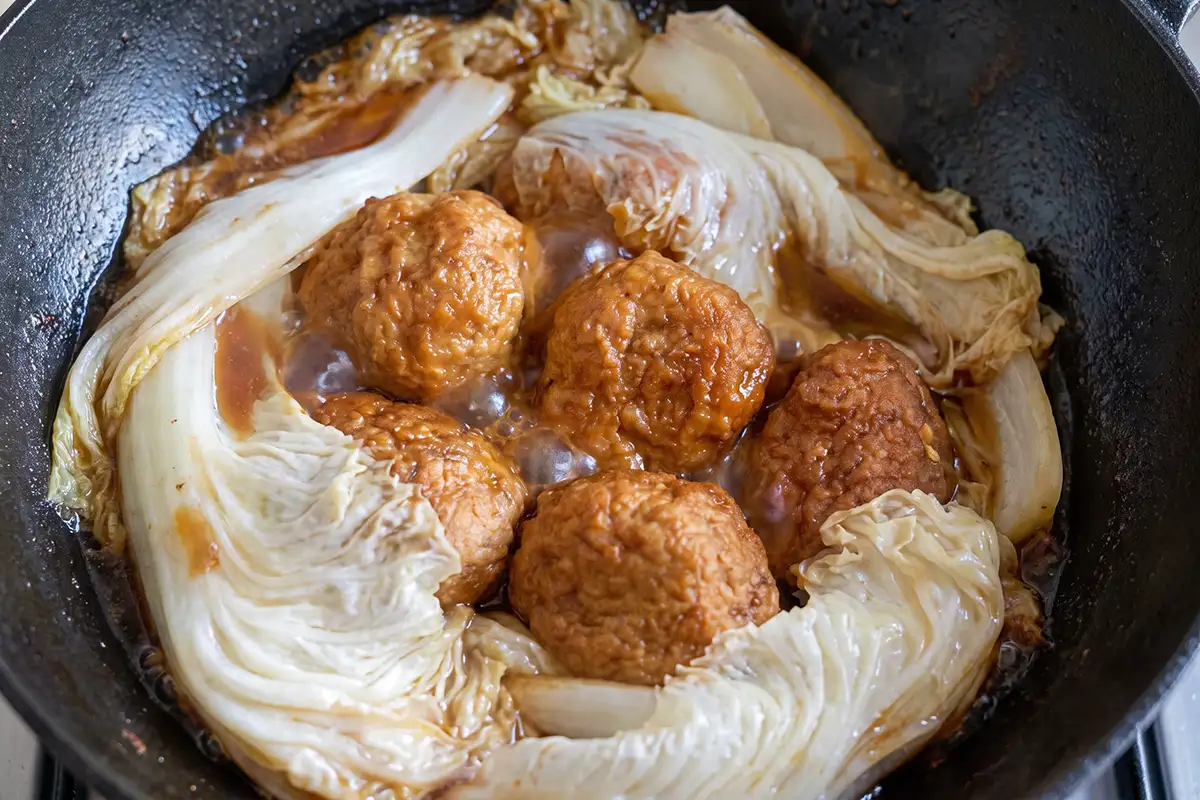
Line the bottom of the pot with a layer of Napa cabbage leaves. This serves two purposes: it prevents the meatballs from sticking to the pot, and the cabbage absorbs some of the pork fat, resulting in a clearer broth.
Place the meatballs on the cabbage leaves, leaving a little space between them. Pour in the chicken broth—the liquid should reach about two-thirds of the height of each meatball; do not completely submerge them.
Heat Control: A Gentle Simmer, Not a Raging Storm
This is where I went wrong when making my second batch.
Bring the broth in the pot to a gentle simmer over medium heat. As soon as you see bubbles, immediately turn the heat down to the lowest setting. Cover the pot.
The surface of the broth should tremble slightly—with a lazy bubble breaking the surface only every few seconds. If you see bubbling furiously, the heat is too high. Violent boiling will cause:
- The meatballs to crack (due to excessive agitation)
- Fat emulsifying into the broth (making it cloudy and greasy)
- The meatballs becoming tough (high heat causes proteins to contract)
Simmer over low heat for 80 to 85 minutes. Set a timer. Don’t lift the lid frequently—every time you do, heat escapes, and the cooking time increases.
I once cooked the meatballs for nearly 2 hours while waiting for another dish to finish. As a result, the meatballs became dry and tough, ruining their texture. For 120-gram meatballs, 80 to 85 minutes is the optimal cooking time.
Three Mistakes I’ve Made
Mistake 1: Using a food processor + over-mixing.
My first batch of meatballs had a dense and chewy texture because I used a food processor and mixed them for too long. Solution: Mince the meat by hand and mix in one direction for just 2–3 minutes.
Mistake 2: Boiling over high heat instead of simmering gently.
My second batch of meatballs had a cloudy and greasy broth because I kept the heat too high. Solution: Once the broth comes to a gentle simmer, reduce the heat to the lowest setting. Maintain only a gentle simmer.
Mistake 3: Overcooking.
My third batch of meatballs became dry and tough because I simmered them for over 90 minutes. Solution: Set a timer for 80–85 minutes. Insert chopsticks into the center of a meatball—they should slide in with almost no resistance. That’s how you know the meatballs are done.
How to Tell When They’re Done
After 80 to 85 minutes, check one meatball:
- Insert chopsticks into the center; they should slide in easily.
- The meatball should be tender and still moist.
- The broth should be clear, not cloudy.
- The cabbage should be tender and slightly translucent.
If the chopsticks meet resistance, cook for another 5 to 10 minutes. However, do not exceed a total cooking time of 90 minutes.
Serving with Ease
Scoop the cabbage into serving bowls. Gently arrange the meatballs on top. Ladle the hot broth over all the ingredients. Sprinkle with green onion for garnish.
This is not a flashy dish. It doesn’t rely on spiciness or vibrant colors to catch the eye. Its charm lies in its restraint—a clear broth, well-rounded seasoning, and a texture that makes you instinctively quiet down after the first bite.
Serve with steamed white rice and cucumber dressed with vinegar as side dishes. The rice will absorb the light broth, while the cucumber will balance out the rich flavors.
Avoid pairing it with another rich stew. One rich dish is enough; otherwise, the entire meal will feel too heavy.
If You Need to Substitute Ingredients
| Ingredient | Substitute |
|---|---|
| Water chestnuts | Lotus root |
| Pork belly | Pork back fat (finely diced) |
| Potato starch | Cornstarch (equal amount) |
| Napa cabbage | Regular cabbage or blanched lettuce leaves |
| Unsalted chicken broth | Light pork broth, or water + ½ teaspoon chicken bouillon powder |
The one ingredient you should never substitute: hand-chopped pork. Store-bought ground pork is too fine in texture. If you must use ground pork, ask your butcher for “coarsely ground pork”—it’s closer to the texture you need.
The Three Versions I’ve Actually Made
Classic Version (Banquet-Style): 70% shoulder + 30% pork belly, meatballs weighing 120 grams, simmered for 85 minutes. Full preparation process. Made only for special occasions and when entertaining guests.
Light Version (Weeknight Dinner): 80% pork shoulder + 20% pork belly, meatballs weighing 80 grams, simmered over low heat for 60 minutes. Although less greasy, it’s still deeply comforting. This is the version I usually make on Wednesdays.
Seafood-Flavored Version: Add 60 grams of chopped shrimp to the pork mixture. Reduce the salt by about ½ teaspoon. Simmer over low heat for 80–85 minutes. The meatballs have a sweeter taste and a richer umami flavor. Perfect for when you want to impress guests without making something too complicated.
How to Handle Leftovers
The meatballs retain their texture well in the broth. Store them in an airtight container in the refrigerator, where they’ll keep for 2 days.
Reheating Instructions: Reheat over low heat on the stovetop until it simmers gently—about 5 to 8 minutes. Do not bring to a rolling boil. Boiling over high heat will ruin the delicate texture you’ve carefully crafted.
After simmering overnight, the flavor often becomes even richer. I’ve prepared this dish a day in advance for dinner parties, and the results have been excellent.
You can also freeze it—freeze the meatballs along with the broth, and they’ll keep for up to 2 months. Thaw overnight in the refrigerator, then gently reheat over low heat on the stovetop.
Quick Answers to Common Questions
Why are my meatballs dense and springy? It’s because you used a food processor or over-mixed the mixture. Next time, mince the meat by hand and limit mixing to 2–3 minutes.
Why is my broth cloudy and greasy? It’s because you’re cooking it over high heat. Bring it to a gentle simmer first, then reduce the heat to the lowest setting. Just keep it at a gentle simmer.
Why did my meatballs crack? You simmered them over too high a heat, or you didn’t roll them thoroughly in the palms of your hands. Roll them in your palms 5–6 times to firm up the surface, then simmer over low heat.
Can I make these using only pork shoulder (without pork belly)? Yes, but the meat will be drier. Add 1 tablespoon of neutral cooking oil to the meat mixture to compensate.
How do I know when the meatballs are done? Insert a pair of chopsticks into the center of a meatball. The chopsticks should slide in with almost no resistance. If it still feels firm, cook for another 5–10 minutes.
Why should the ginger water be added in three batches? The meatballs will gradually absorb the liquid. Adding too much at once will make the mixture too wet or cause it to separate.
Can I prepare this in advance for a dinner party? Yes. Simmer for 80–85 minutes, let it cool in the broth, then refrigerate overnight. Before serving, gently reheat over low heat on the stove. After stewing overnight, the flavors will become even richer.
Is this dish supposed to be this light? Yes. The essence of Shizitou lies in restraint—a clear broth, mild seasoning, and a unique texture. It’s not spicy, nor is it flashy. This is the very essence of Huaiyang cuisine.
Conclusion
“Shizitou” has taught me that some dishes shouldn’t be rushed. Chopping the meat by hand takes an extra five minutes. Stirring in one direction for just the right amount of time is crucial. Simmering over low heat rather than boiling vigorously—that’s the secret to tender meat.
I’ve made meatballs with tough, dense meat, a cloudy, greasy broth, and versions that were dry and overcooked. All these failures taught me that it is precisely these subtle steps that bring this dish to perfection.
Why not give it a try on a quiet, unhurried evening? After the first bite, a hush will fall over the dinner table—and for a dish like this, that is the highest praise.
Related Articles:
- Squirrel Mandarin Fish: With this signature Jiangsu dish, I’ve cut the fish too deep, fried it until it was too soft, and poured the sauce on too early—all three times
- Wuxi Braised Pork Ribs: With this classic Jiangnan dish that blends sweet and salty flavors, I’ve made the sauce too thick, under-seasoned it, and failed to achieve the right color—all three times