The Fried Rice That Made Me Rethink Everything
Rice stuck together like ruined congee? A greasy, slippery bowl that coated every bite? Flavor so muddled you couldn’t tell ham from corn? After ruining Yangzhou fried rice three different ways, I finally learned the secrets: overnight short-grain rice coated in egg yolk, toss without pressing, and season along the wok edge.

The first time I tried Yangzhou fried rice, I was so captivated by its deliciousness that I still can’t stop thinking about it. At the time, I thought I’d try recreating it at home. It’s just fried rice, right? Leftover rice, a few eggs, some ingredients—stir-fried over high heat. How hard could it be?
To my surprise, the rice I ended up with was like a sticky, gooey mess. I’d used freshly cooked rice and pressed down on it with the spatula as if I were crushing stones. My wife looked at the rice in the bowl and said, “This looks like ruined congee.”
The second time, I used leftover rice from the night before. The grains were indeed looser. But the dish was way too greasy—heavy and slimy. With every bite, my lips would get coated in oil. The flavor was also bland and unremarkable.
I kept trying afterward. Although the grains were loose and the dish wasn’t greasy, the taste was always the same. I couldn’t tell which were corn kernels and which were ham bits. The whole dish was just… brownish, with a muddled, indistinct flavor.
It was only then that I realized Yangzhou Fried Rice is by no means “just fried rice.” The simpler the dish, the more care and attention it requires. Here are the tips I ultimately came up with.
Ingredients
- Overnight-cooked Japanese rice—300 grams (short-grain rice, refrigerated overnight)
- Eggs—3
- Fresh shrimp—60 grams (peeled and deveined)
- Ham (or any cured ham)—85 grams (diced)
- Sweet corn kernels—40 grams
- Carrot—40 grams (finely diced)
- Green peas—25 grams
- Green onion—15 grams (white and green parts separated)
- Ginger water—20 milliliters (soak ginger slices in water for 10 minutes)
- Shaoxing wine – 1 teaspoon
- Light soy sauce – 1 teaspoon
- Salt – 2 grams (about ½ teaspoon)
- White pepper – a pinch
- Neutral cooking oil – 3 tablespoons
Prepare the Rice a Day in Advance
This is the most important step—I learned this the hard way.
Please cook the rice one day in advance. Spread the rice out on a tray, let it cool, then refrigerate it overnight. The starch on the surface of the rice grains will undergo “re-starchification”—a technical term meaning the grains will harden and no longer stick together. When stir-frying with overnight rice, the grains will remain loose. Freshly cooked rice, on the other hand, will turn into a sticky, mushy mess no matter how high the heat is in the pan.
If you absolutely must use freshly cooked rice (for emergencies only), spread it out on a tray and refrigerate it for 40 to 60 minutes. Although the results won’t be as good as with overnight rice, it’ll do in a pinch.
Before cooking, use your hands to break up any clumps of rice. Never press down on or mash the rice. Crushing the grains releases starch, causing the rice to become sticky again.
Tips for Coating Rice with Egg
This is something I didn’t learn until I began seriously studying Yangzhou Fried Rice.
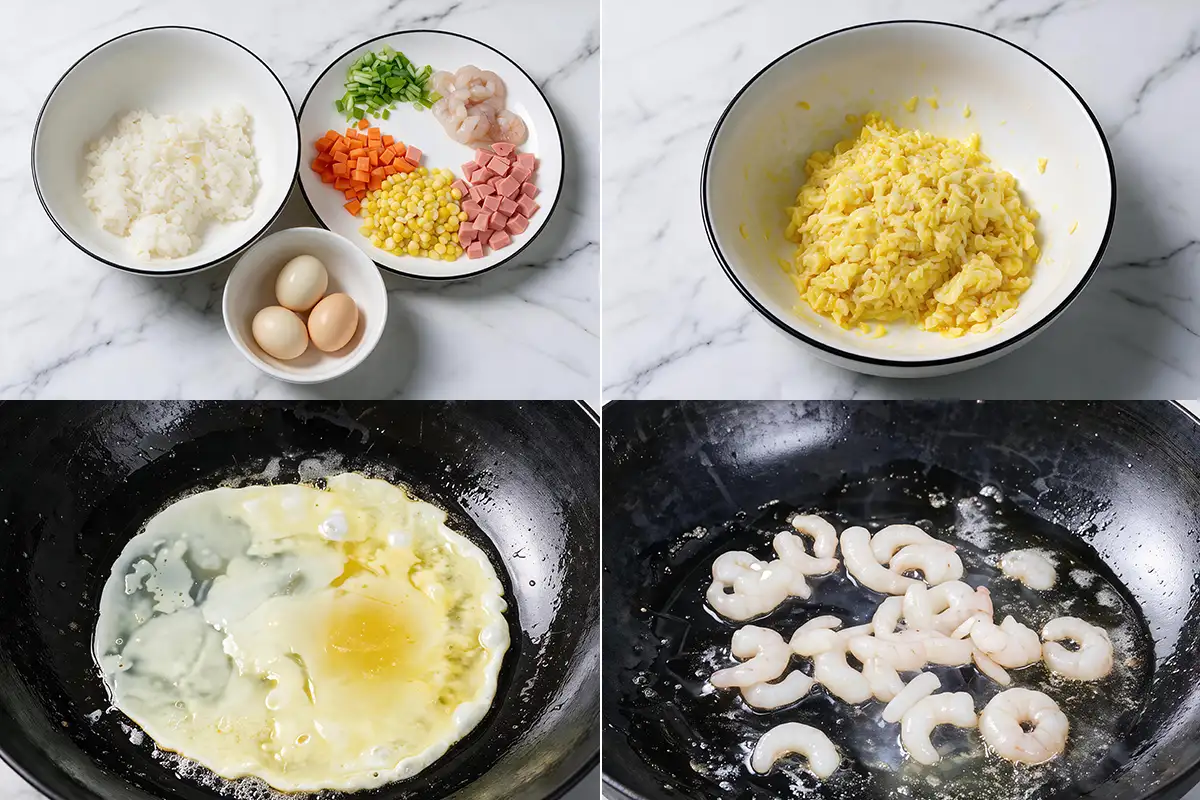
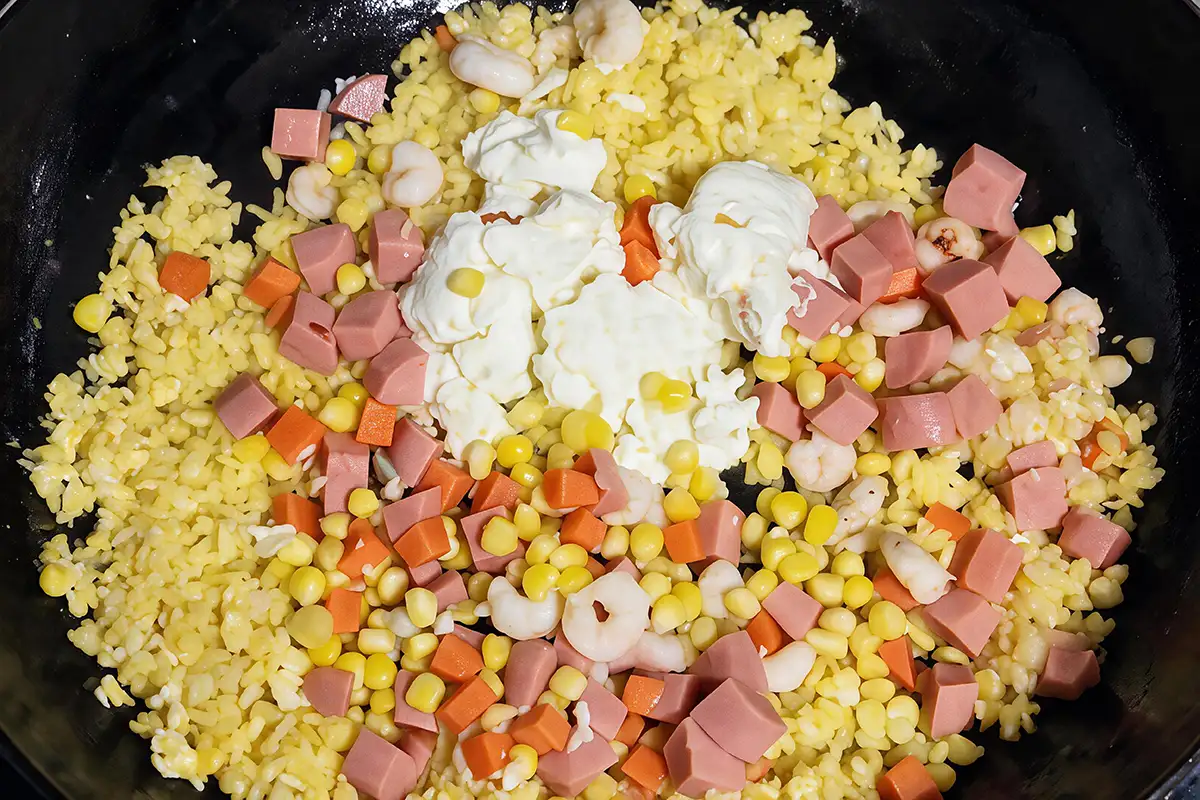
Separate the egg yolks from the whites and beat the egg yolks in a bowl. Pour the egg mixture over the day-old rice. Mix well with your hands until each grain of rice is coated with a thin layer of egg. The rice will take on a slightly yellowish and moist appearance—that’s exactly what you want.
Why do this? The egg forms a thin protective film around each grain of rice. When stir-fried, this film sets, preventing the grains from sticking together. It also gives the rice that golden hue you see in restaurants.
What about the egg whites? Don’t worry—I’ll explain that in a moment.
Get Everything Ready Before Turning on the Heat
Yangzhou Fried Rice comes together quickly—it takes about 10 minutes total, maybe even less. If your wok is already smoking and you’re still chopping vegetables, you’re bound to mess it up. I’ve made this mistake so many times I’m almost too embarrassed to admit it.
Get all your ingredients ready first:
- Clean the fresh shrimp, remove the veins, and set aside the shrimp meat (frozen shrimp meat works too).
- Dice the carrots.
- Prepare sweet corn kernels.
- Dice the ham (if not already diced).
- Stir-fry the shrimp: Add the cleaned shrimp to cooking wine and a pinch of salt, then stir-fry briefly until the shrimp turn pink and curl slightly.
- Stir-fry the egg whites: Beat the remaining egg whites, pour them into a nonstick pan lightly coated with oil, and cook over low heat. Once the egg whites have set into thin sheets, slide them out of the pan and set aside.
- Separate the white part of the scallion (for flavor) from the green part (for garnish).
Start Cooking—Quickly and with Focus
Step 1: Build the Aromatic Base
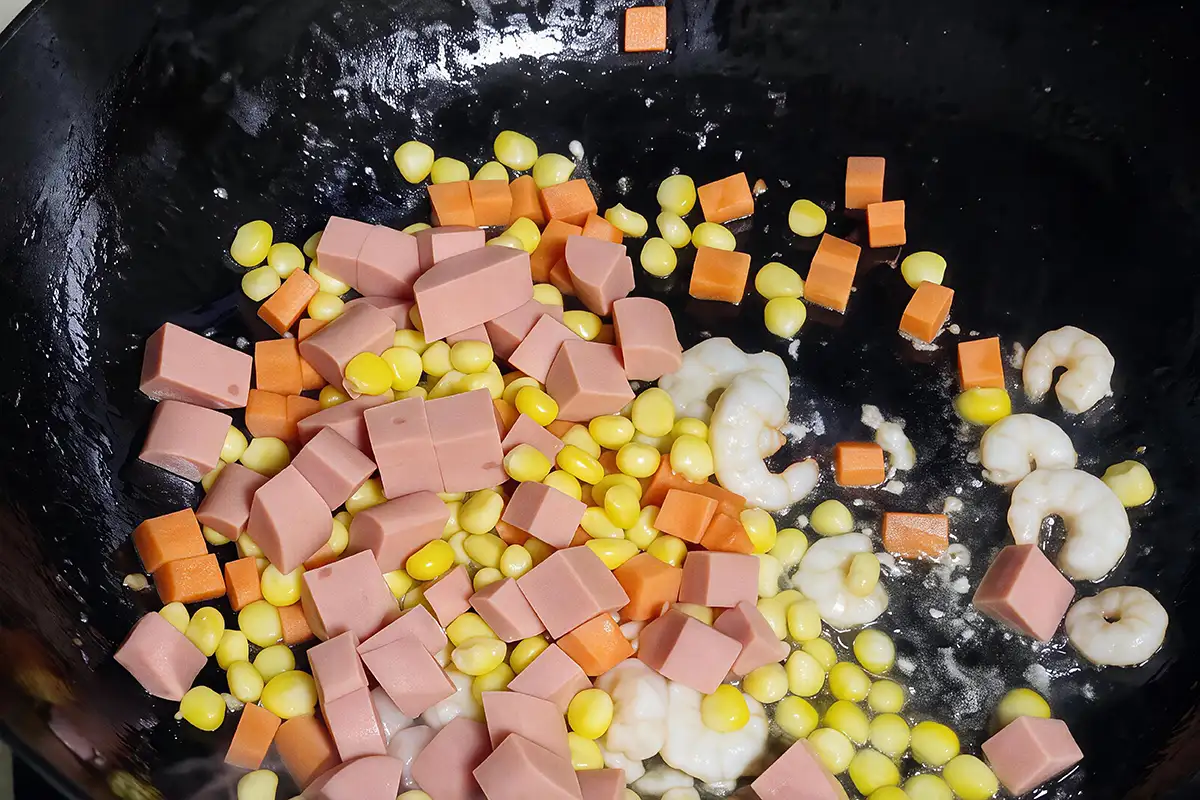
Heat a wok or heavy-bottomed skillet over high heat until it just begins to smoke. Add 1 tablespoon of oil. Add the white parts of the scallions—stir-fry for a few seconds until you can smell their aroma. Be careful not to let them burn.
Add the diced ham, diced carrots, corn kernels, and green peas. Stir-fry for about 1 minute, until all ingredients are heated through and fragrant. Quickly add the shrimp—just 15 seconds—then remove all ingredients from the pan and set them aside.
This step is crucial. If you leave the ingredients in the pan while stir-frying the rice, they’ll overcook, and their distinct textures will be lost. The shrimp will become rubbery, and the green peas will lose their crispness.
Step 2: Stir-Frying the Rice
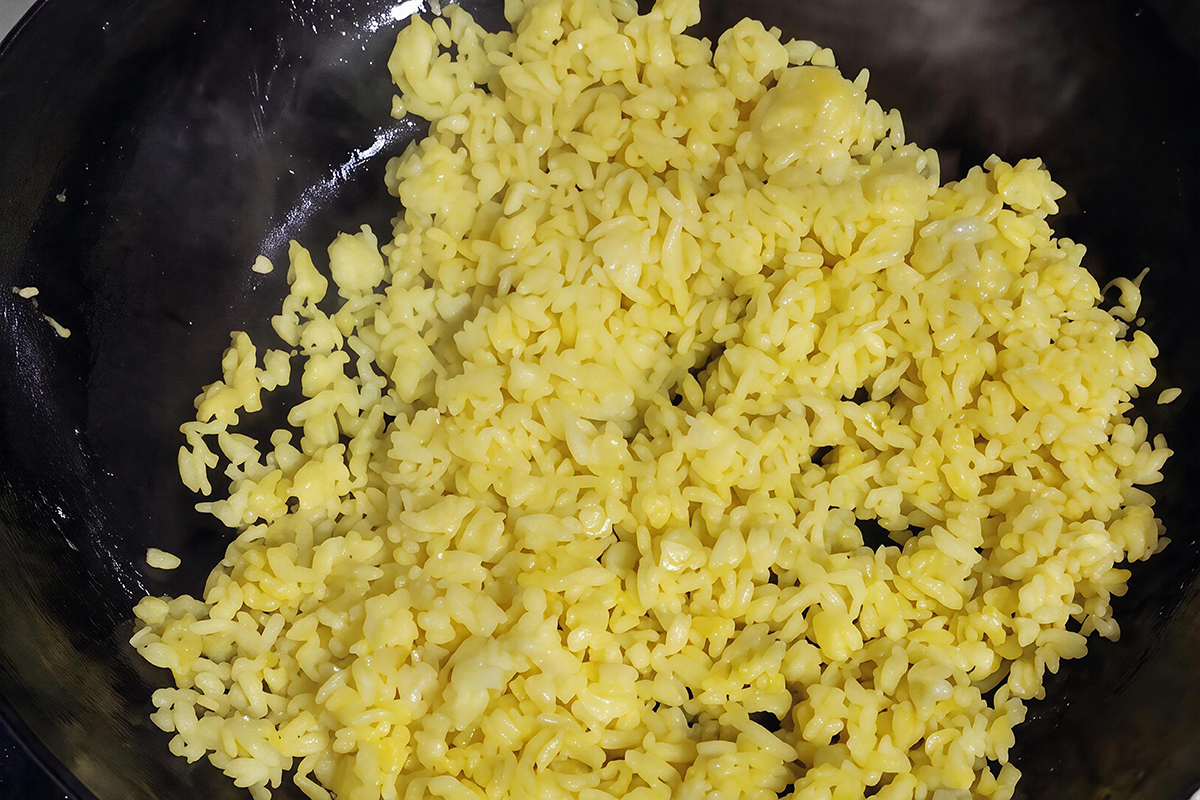
Add 1 tablespoon of oil to the wok. Add the rice coated in egg.
Here’s the trick: Use a lifting and tossing motion. Use the spatula to scoop up the rice from the bottom, lift it, and let it fall naturally. Do not press down with the spatula; do not crush the rice. Just lift and toss.
Stir-fry over high heat for about 3 to 4 minutes. The grains should begin to separate and take on a slight sheen, and they should be thoroughly heated through. You’ll notice the yellow hue from the egg coating gradually turn a light golden color.
Step 3: Seasoning
Now—and only now—add the seasonings.
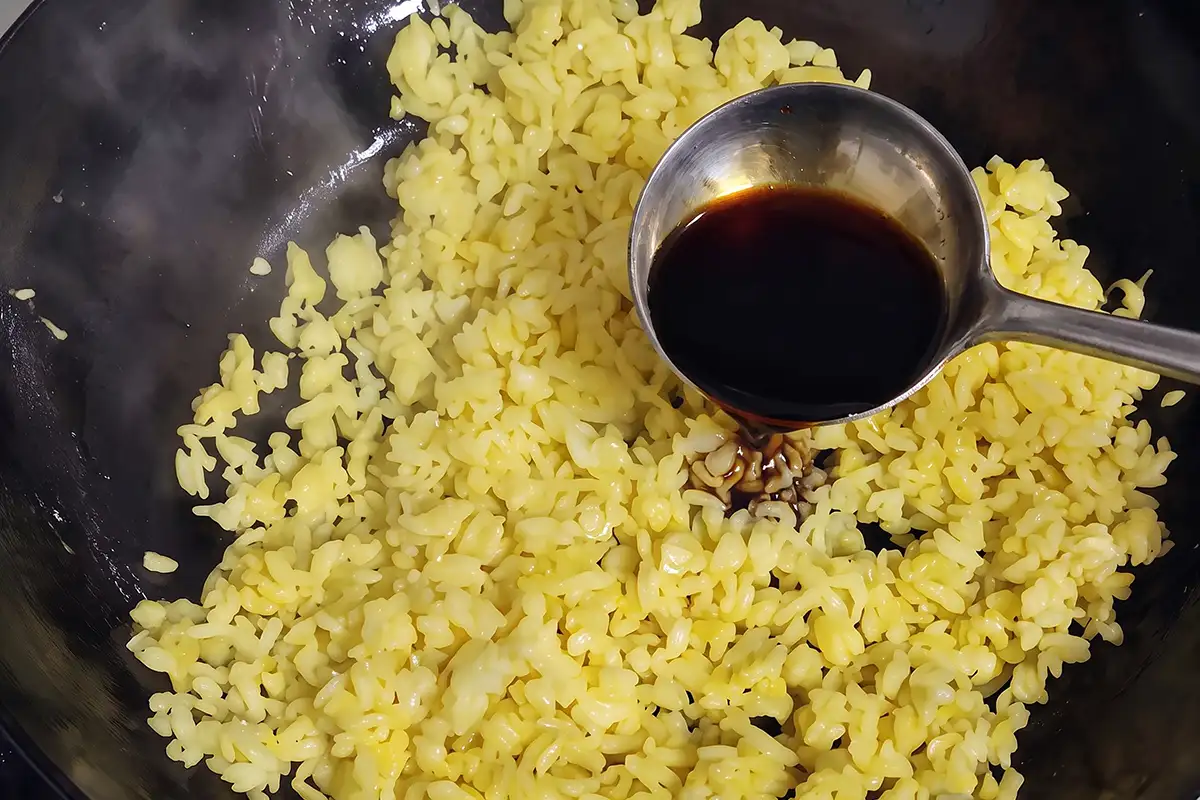
Drizzle the light soy sauce along the edge of the wok, not in the center. The edge is where the heat is highest. When the soy sauce comes into contact with the scorching-hot metal surface, it will instantly vaporize, releasing its aroma without adding too much moisture to the rice. If you pour it in the center, you’ll just steam the rice.
Add salt and white pepper. Stir-fry until well combined.
Step 4: Combine All Ingredients
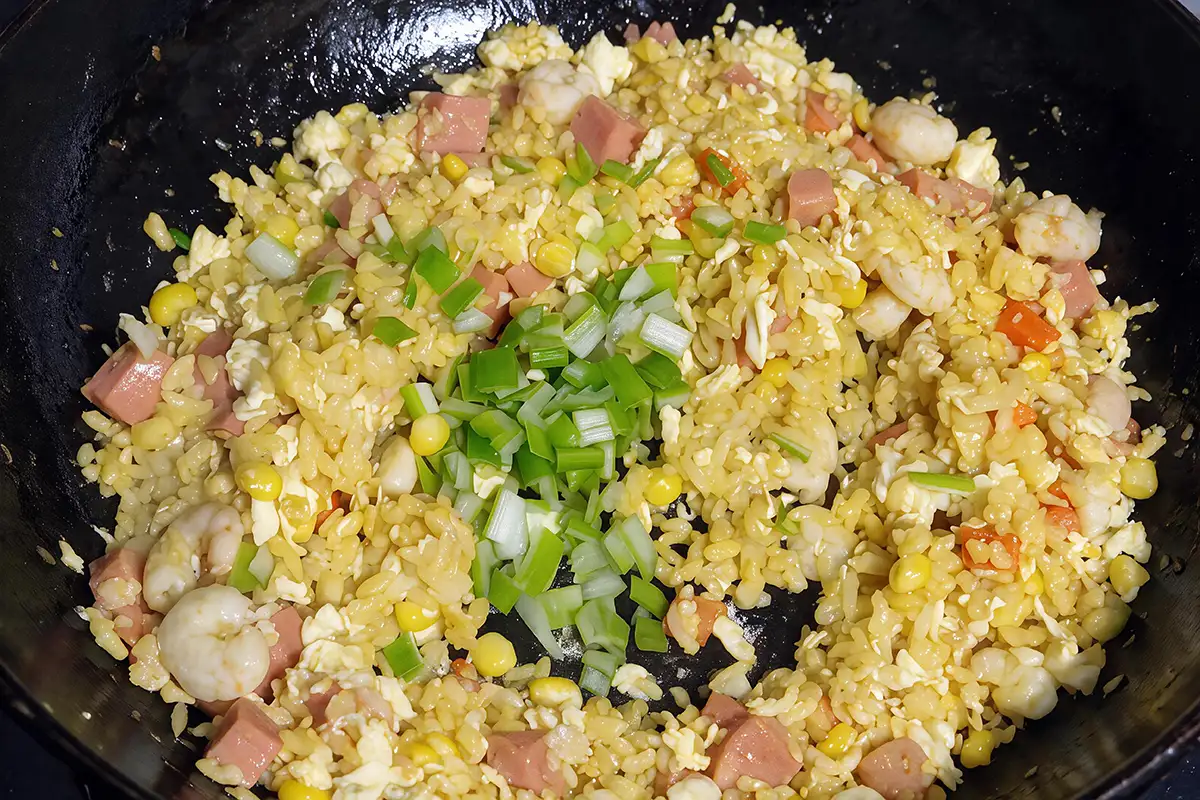
Return the stir-fried ingredients to the wok. Stir-fry for 45 to 60 seconds, until all ingredients are thoroughly heated and well combined.
Add the green parts of the scallions. Stir-fry once or twice.
Serve immediately. Fried rice can’t wait.
Lessons I Learned from These Experiences
Mistake 1: Using fresh rice and pressing it flat.
My first batch of fried rice turned into a sticky, glue-like mess—a total disaster—because I used fresh rice and pressed it flat like I was making rice cakes. Solution: Use day-old rice, toss gently, and never press it down.
Mistake 2: Too much oil, ingredients too wet.
My second batch of fried rice was greasy because I used too much oil and didn’t drain the ingredients thoroughly. Solution: Measure the oil carefully (no more than 3 tablespoons), and pat each blanched ingredient dry with paper towels.
Mistake 3: Adding soy sauce too early and piling ingredients too densely.
My third batch turned into a sticky mess because I added the soy sauce too early and stir-fried all the ingredients at once. Solution: Add the soy sauce last, pouring it along the edge of the wok. Stir-fry the ingredients in batches; don’t add them all at once.
Mistake 4: Overfilling the wok.
Once, to save time, I tried to stir-fry 600 grams of rice all at once. The wok ended up so packed that I couldn’t stir the ingredients at all—they just steamed. Now I stick to 300 grams per batch. If I need more, I cook it in two batches.
If You’re Missing Ingredients
Yangzhou Fried Rice is very flexible. When I don’t have all the ingredients in my fridge, here’s how I substitute:
| Ingredient | Substitute |
|---|---|
| Ham | Char siu, or simply omit |
| Fresh shrimp | Frozen shrimp (thawed and patted dry) |
| Sweet corn kernels | Peas, or omit |
| Diced carrots | Diced bell peppers, or omit |
| Japonica rice | Jasmine rice works too, but reduce the amount of egg mixture slightly |
| No ham, no shrimp | Use just eggs, corn, and carrots—it’s all about technique; it’ll still turn out great |
The one non-negotiable: day-old rice. All other ingredients can be substituted, but the rice must be day-old.
Three Versions I’ve Actually Made
Simple Version (Weeknight Dinner): Rice + a thin coating of beaten egg + one type of protein (shrimp or ham) + corn and carrots + chopped green onions. That’s it. Ready in 10 minutes, and it tastes amazing.
Classic Version (When You Want to Impress): All five ingredients—shrimp, ham, corn kernels, diced carrots, and green peas. Authentic flavor.
Weekend Upgrade: Same as the Classic Version, but add 1 tablespoon of crab roe sauce at the end. The aroma is simply incredible. Save this for special occasions.
Quick Answers to Common Questions
Why is my rice still clumpy? It’s because you used freshly cooked rice, or you pressed it down. Please use day-old rice and just fluff it up.
Why is my fried rice greasy? You used too much oil, or the wok wasn’t hot enough. Measure the oil carefully and let the wok smoke before adding any ingredients.
Why can’t I taste the individual flavors of each ingredient? This is because you overcooked the ingredients or overcrowded the pan. We recommend stir-frying the ingredients in batches, setting them aside, and then returning them to the pan at the end.
Can I make a vegetarian version? Yes. Simply omit the shrimp and ham. Add more corn, carrots, and green peas to enrich the texture. Use mushroom seasoning to enhance the flavor profile.
I don’t have a wok. Can I use a regular skillet? Yes, but choose one with a thick bottom (cast iron or stainless steel). Nonstick pans cannot reach the high temperatures required for fried rice. If you must use a nonstick pan, cook in small batches.
Can I make this ahead of time and reheat it? Fried rice is best eaten fresh. Reheated fried rice loses its distinct, separate grain texture. If you have leftovers, you can reheat them in a hot pan with a little water—but don’t expect the flavor to be as good as when it’s freshly made.
Why pour soy sauce along the edge of the wok? The edge of the wok is the hottest part. The soy sauce will evaporate quickly, releasing its aroma without adding moisture to the rice. If poured in the center of the wok, it will actually steam the rice and make it mushy.
How much soy sauce should you use? Use 1 teaspoon of soy sauce for every 300 grams of rice. The fried rice should have a light color. Too much soy sauce will darken the rice and make it look cloudy.
How I Serve It
As soon as the fried rice comes off the heat, I portion it out into individual bowls. Since the texture deteriorates quickly, everyone should dig in right away.
I usually serve it with:
- A bowl of clear soup (egg drop soup or miso soup)
- A simple vegetable dish (stir-fried seasonal vegetables)
That’s all. The fried rice is the star of the show. Don’t clutter the table with greasy dishes that compete with it.
Final Thoughts
Fried rice has taught me that good cooking isn’t about fancy ingredients or complicated techniques, but about paying attention to the details: draining the ingredients well, using day-old rice, not overcrowding the pan, and seasoning at the very end.
I’ve had times when the rice clumped together, turned greasy, or even burned into a sticky mess. It was precisely these failures that helped me grasp the key points I’ve just outlined.
Why not give it a try? Start with a “half-portion” version—just eggs, scallions, corn, carrots, and ham. Once you can keep the grains separate and achieve a light, refreshing flavor, then add more ingredients. You’ll surely master the tricks faster than I did.
Related Articles:
- Yangzhou Lion’s Head: I failed three times at this classic Huaiyang dish due to over-stirring, overcooking, and rushing the process
- Wuxi Braised Pork Ribs: I failed three times at this classic Jiangnan dish—with its blend of sweet and salty flavors—due to reducing the sauce too much, under-seasoning, and improper browning